

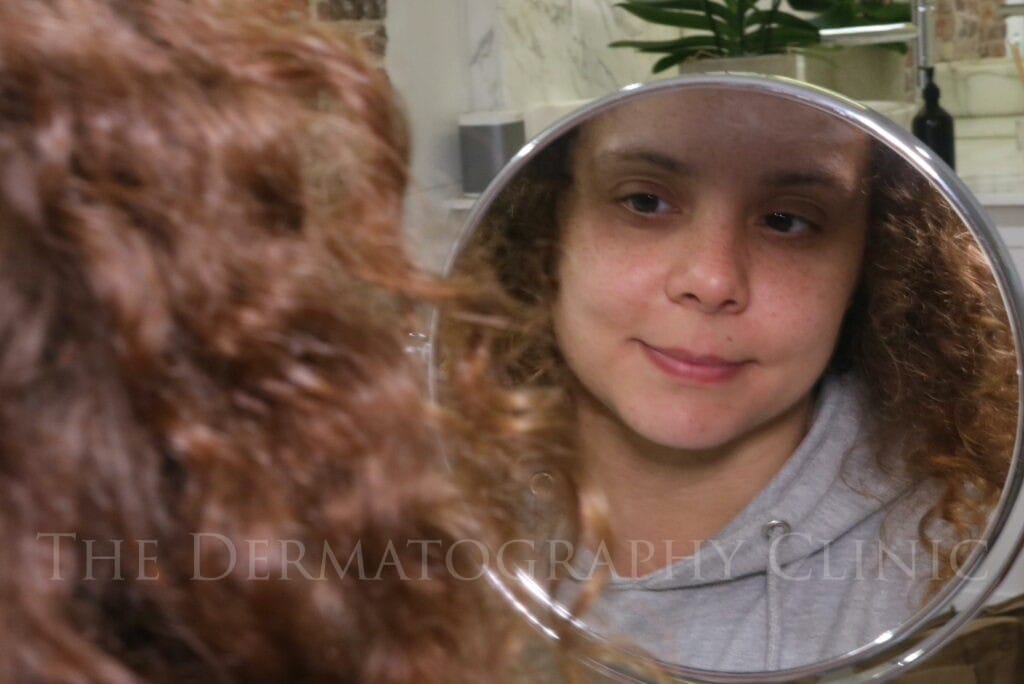
Expert insights from Renée – Founder & Lead Practitioner, The Dermatography Clinic, Spitalfields, London.
Opening Observation
Over years of consultations, one of the clearest distinctions I’ve noticed is that scalp micropigmentation for women requires a very different approach to male treatments.
Not simply in technique, but in how the entire treatment is assessed, planned, and judged for suitability.
With men, the goal is usually to replicate the appearance of closely cropped or shaved hair, where the scalp becomes a controlled, uniform visual surface.
With women, the starting point is almost always different — and that difference changes everything.
Knowledge Gap
There is a common assumption that scalp micropigmentation is a universal technique that can be applied in the same way regardless of gender or hair type.
In reality, female hair loss presents a much more complex visual environment.
Many women researching SMP are dealing with diffuse thinning, medical hair loss, or changes in density rather than complete shaving or uniform baldness.
This means the treatment is not simply about adding density — it is about working within an existing, often highly variable hair structure.
Without recognising this, expectations can easily become misaligned with what is realistically achievable.
Why It Matters
The key issue is that scalp micropigmentation is a visual illusion technique, not a reconstruction of hair itself.
It works by creating the appearance of density within a controlled visual field.
For that reason, the surrounding hair environment is critical.
When there is a significant contrast between treated and untreated areas — or when long hair sits next to heavily pigmented scalp — the result can draw attention rather than reduce it.
This is why female cases require more careful assessment, particularly where hair loss patterns do not present evenly.
Expert Assessment Framework
Starting point: short hair vs long hair environments
In most male cases, the scalp is shaved or closely cropped.
This creates a relatively uniform 2D surface, which allows pigmentation to blend predictably into the overall visual field.
With women, the situation is different.
Treatment is almost always carried out alongside longer hair, meaning the scalp exists in a more complex 3D environment with varying density, direction, and coverage.
This alone changes the treatment planning process significantly.
Suitability is not universal
There are situations where scalp micropigmentation is appropriate for women, and others where it is not.
For example:
- In cases of diffuse thinning where there is still existing hair across the area, SMP can add subtle density and create a more balanced appearance.
- In post-transplant or thinning hair scenarios, it can help soften visual gaps and improve overall uniformity.
However, in cases such as frontal alopecia with complete loss in a defined area, the outcome is far less predictable.
In these situations, there is often a hard transition between hair-bearing areas and completely bare scalp.
From experience, this can make pigmentation more visible rather than less, as it does not blend into a consistent surrounding density.
In some cases, it is not considered a suitable treatment option.
Hairline design in women
Another key difference is the hairline.
With male SMP, even when kept soft, there is usually still a defined edge or frame to the face.
In female treatments, a defined hairline is rarely appropriate.
Instead, the approach must follow natural irregularity, with no structured or artificial border.
The aim is not to create a hairline — it is to support the appearance of natural density.
Pigment selection and colour realism
Colour choice plays a critical role, particularly for women with lighter or more varied hair tones.
Many traditional SMP approaches rely on a limited pigment range, often adjusted only through dilution.
While this may be effective in shaved male scalp cases, it can create unnatural tones in female cases, particularly where the surrounding hair is light, fine, or multi-tonal.
In practice, pigment selection must be adapted carefully to avoid unnatural contrast or cooler tones that can become visually dominant under certain lighting conditions.
The goal is always subtle integration rather than visual definition.
Session planning and density expectations
Female cases often require a different pacing approach.
Because the objective is usually subtle visual improvement rather than full scalp replication, treatment is built gradually over multiple sessions.
In longer hair environments, achieving a natural result often requires more refinement, not more intensity.
This is an important expectation to set early in consultation.
Emotional context and suitability boundaries new improved
One of the most important aspects of female SMP consultations is understanding the emotional impact of hair loss.
For many women, hair loss is not simply a cosmetic concern. It can affect confidence, daily routines, social situations, and the way they feel about themselves. By the time they seek advice, many have already explored multiple solutions and are hoping that SMP may finally provide an answer.
One consultation that has stayed with me involved a woman with frontal alopecia. She was extremely distressed by the hair loss and very determined to have treatment. In fact, she repeatedly asked me to proceed despite my concerns.
The difficulty was not understanding why she wanted SMP. The difficulty was knowing that SMP was unlikely to create the result she was hoping for.
With frontal alopecia, there can be a distinct band of completely bare scalp before the existing hair begins. Unlike diffuse thinning, where pigmentation can blend between existing hairs and create the illusion of greater density, there may be very little surrounding hair structure to integrate with.
In this particular case, a previous practitioner had already attempted to address the area using visible pigmented lines that had healed poorly. Rather than creating the appearance of hair, the result drew attention to the treatment itself.
After assessing the area, my concern was that further pigmentation would create the same fundamental problem. There would still be a flat pigmented surface followed by an abrupt transition into natural hair growth. From a visual perspective, it would risk looking like a tattoo sitting in front of the hair rather than creating a believable illusion of density.
I declined treatment even though the client desperately wanted it, because I genuinely believed it would not improve her appearance.
She was understandably disappointed when I explained my concerns. She wanted a solution, and I genuinely wished I could provide one. However, my view was that further SMP would not create an improvement that I could confidently stand behind. Suitability cannot be determined by how strongly someone wants treatment. It has to be determined by whether the treatment is likely to produce a natural and meaningful improvement.
Sometimes the most responsible decision is not to proceed. In my experience, being honest about limitations is just as important as recognising possibilities. Not every hair loss pattern is suited to SMP, and part of responsible treatment planning is being prepared to say so.
During consultations, I often ask myself a simple question: would I recommend the same course of action if this were a close family member seeking my advice? In this case, the answer was no. My recommendation was the same advice I would have given to someone I cared about personally.
Rather than proceeding with treatment, I suggested alternative options that were more likely to achieve a satisfactory cosmetic outcome, including wigs and other non-permanent solutions.
Suitability cannot be determined by how strongly someone wants treatment. It has to be determined by whether the treatment is likely to produce a natural and meaningful improvement. If I do not believe a procedure will improve the overall appearance, I do not believe it should be performed.
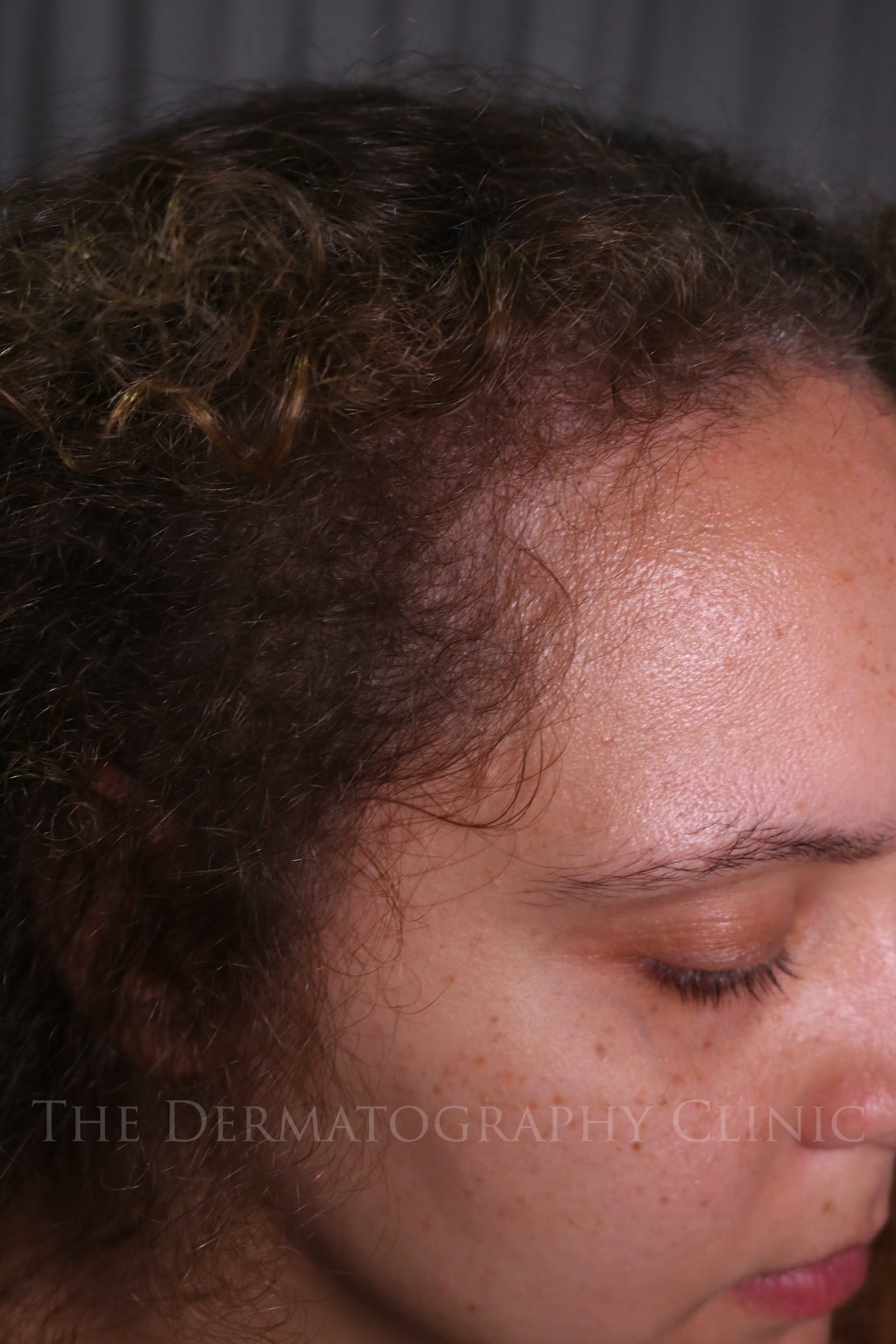
Example of Female Scalp Micropigmentation in Long Hair Environments
-

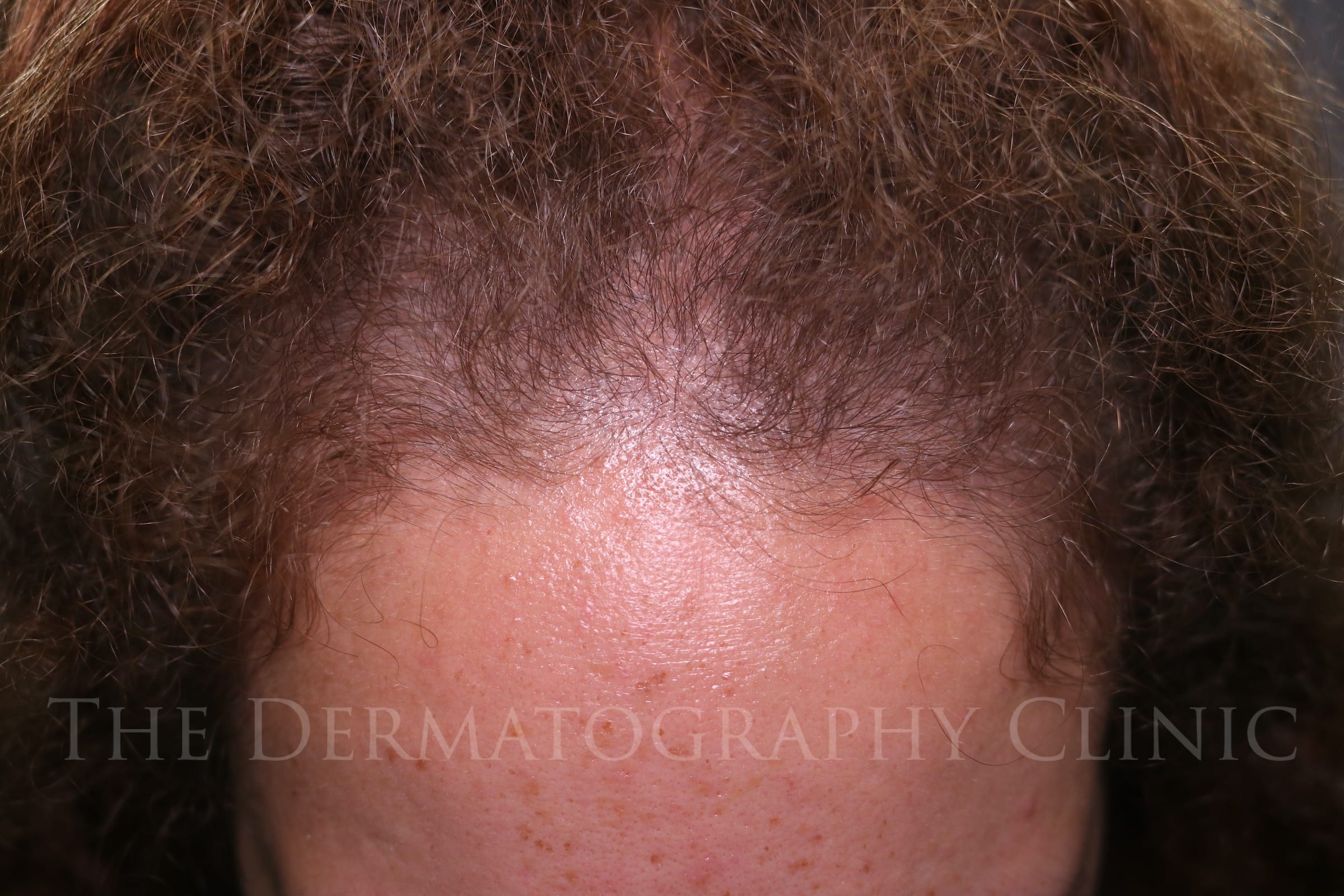
- Frontal view showing diffuse thinning and reduced density across the frontal hairline area prior to treatment.
-
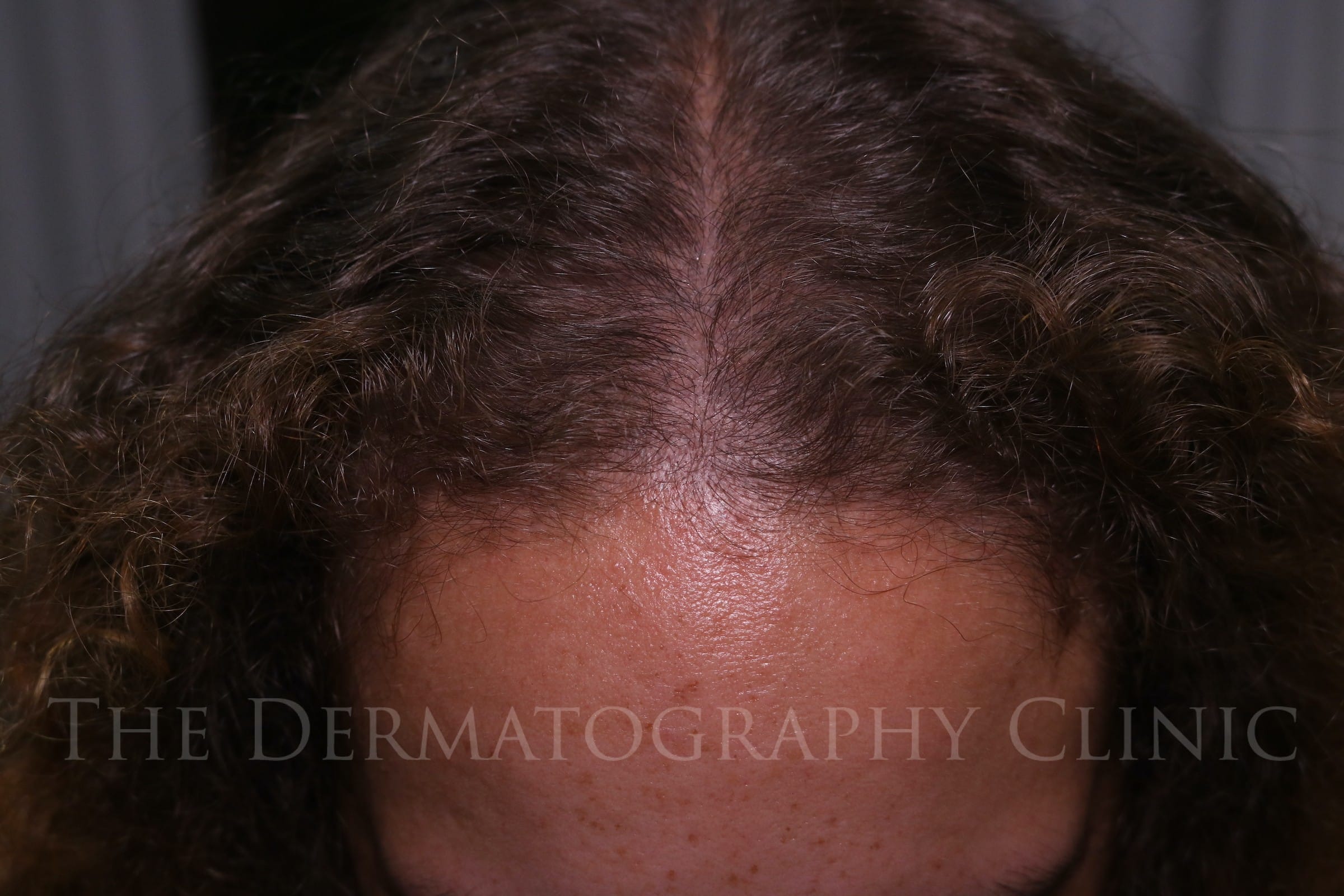
- Healed result showing improved visual density and natural blending within the frontal hairline area.
-
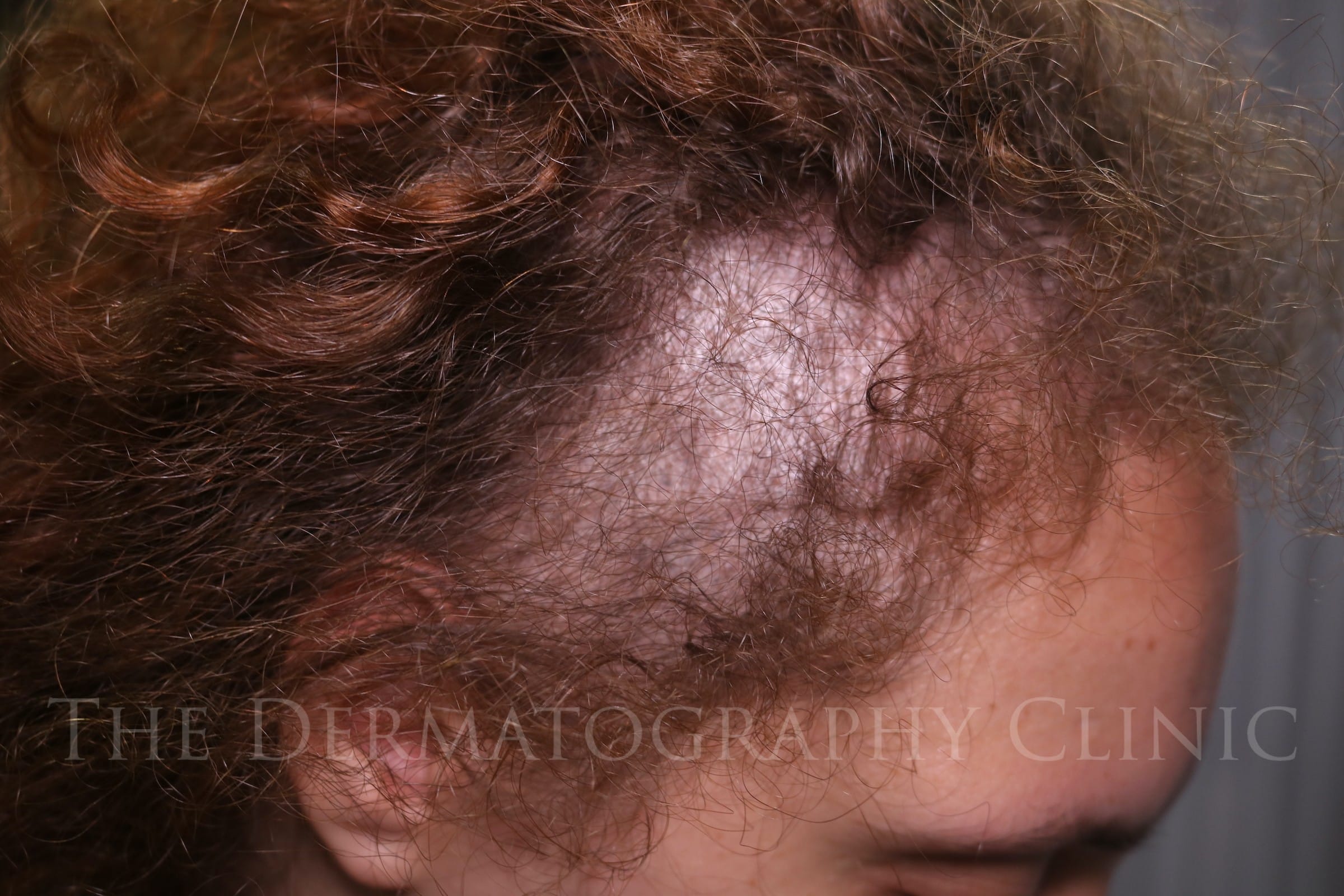
- Profile view showing reduced density within the temporal region in a long hair environment prior to treatment.
-

- Healed profile result showing improved density and soft integration within the temporal region.
Aftercare and lifestyle considerations
Aftercare is another area where female treatments require additional planning.
The requirement to keep the scalp dry for several days post-treatment can be more challenging in longer hair scenarios.
This is especially relevant for clients who:
- wear wigs
- have client-facing roles
- or manage longer hair that is more difficult to keep fully protected during healing
These factors need to be considered before treatment begins, not after.
Closing Perspective
Female scalp micropigmentation can be highly effective when applied in the right context, with appropriate expectations and careful assessment of suitability.
The most important part of the process is not the treatment itself, but the decision-making that leads to whether it should be carried out at all.
In my experience, the best long-term outcomes come from conservative planning, honest consultation, and a focus on natural balance rather than visual transformation.
Ultimately, the goal is not simply to perform treatment. It is to help each person understand their options, assess what is realistically achievable, and make decisions that support the best long-term outcome for their individual situation.
Frequently asked questions
Is scalp micropigmentation suitable for women with thinning hair?
In many cases, yes. SMP can be suitable for women experiencing diffuse thinning where there is still existing hair to work with. The key factor is whether the treatment can blend naturally into the surrounding density. Each case needs to be assessed individually.
Can SMP be used on long hair?
Yes, but long hair changes how the treatment is planned. The scalp is no longer a uniform shaved surface, so the pigment has to be integrated carefully within a more complex visual environment. This usually requires a more conservative and layered approach.
Does SMP work for frontal alopecia in women?
Not always. In cases of complete frontal hair loss where there is a clear band between bald scalp and existing hair, SMP may not create a natural result. In some cases it can draw more attention rather than reduce it. These cases need very careful assessment and are not always suitable for treatment.
Will SMP make my hair look thicker or just darker?
It can create the visual effect of increased density, but it does not change the hair itself. The improvement comes from reducing contrast between scalp and hair, not by adding texture or volume.
Does pigment colour match blonde or light brown hair?
Yes. Pigment selection is adapted depending on natural hair colour and skin tone. In lighter hair cases, this becomes particularly important, as the goal is subtle integration rather than definition or contrast.
How many sessions are needed for female SMP?
It is usually around three sessions, but this can vary. Female cases often require a more gradual build-up because the aim is subtle density rather than full scalp replication. Longer or thicker hair can also require additional refinement sessions to achieve a natural blend.
When is SMP not recommended?
SMP is not suitable for every pattern of hair loss. It is generally not recommended in cases where there are large areas of complete hair loss with no surrounding density to blend into. Every case is reviewed individually, and honest feedback is given during consultation, including when treatment is not appropriate.
Consultation and suitability assessment
If you are considering scalp micropigmentation for female hair loss, the most important first step is an honest assessment of suitability.
Every case is different, and the outcome depends on hair density, pattern of loss, and how the treatment would integrate with your existing hair.
If you would like to explore whether SMP is appropriate for your situation, the first step is a consultation where we can review your hair loss pattern and discuss realistic outcomes before any treatment is considered.