

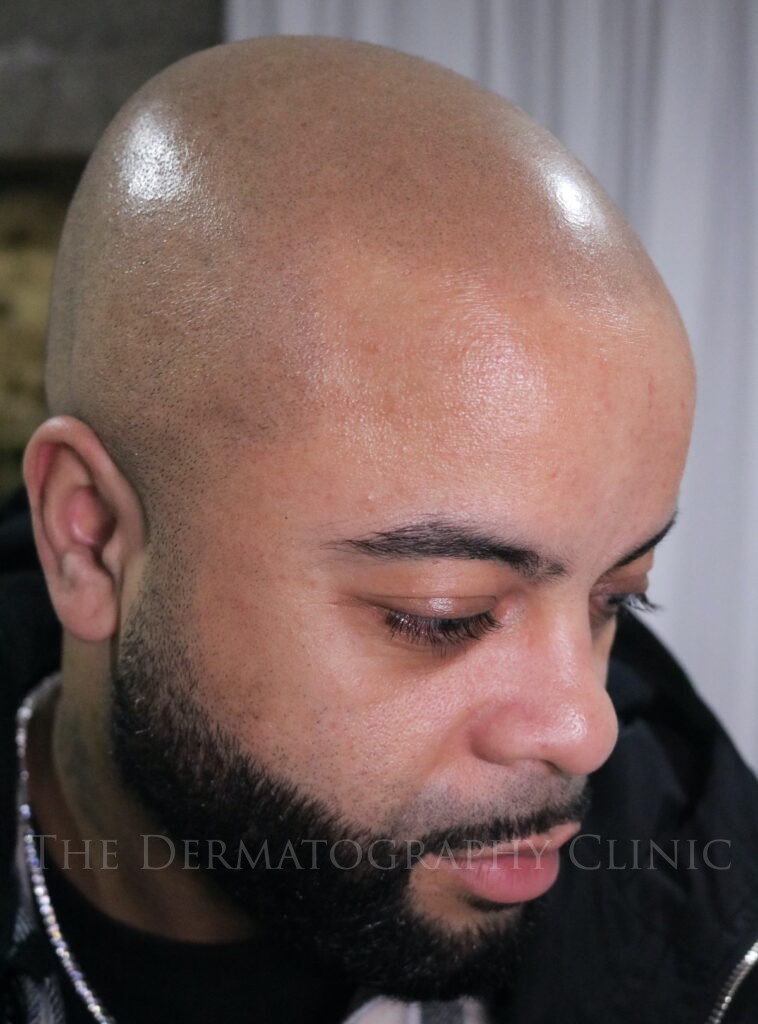
Expert insights from Renée – Founder & Lead Practitioner, The Dermatography Clinic, Spitalfields, London.
Why natural results are defined by balance, not just the hairline
Scalp micropigmentation has become far more widely accessible over the past decade. With that accessibility has come a wider range of outcomes. Some results are highly refined and subtle, integrating seamlessly into the existing hair pattern. Others are more immediately detectable.
Poorly executed hairlines remain one of the most obvious signs of weak SMP, but focusing solely on the front edge overlooks where much of the technical skill lies.
While the hairline often receives the greatest attention, it is only one element of a successful SMP result. The true test of expertise extends beyond the front edge.
Having worked with scalp micropigmentation in the UK for many years, I’ve found that natural-looking results are rarely defined by the hairline alone. Instead, they depend on how every area of the scalp works together to create a believable overall appearance.
In this article, I’ll explain the factors that separate natural-looking SMP from results that become visually detectable, and how to assess treatment quality.
SMP is not judged from one angle
A common assumption is that scalp micropigmentation is successful if the front hairline appears natural. While the hairline is important, it is only one component of overall visual perception.
In reality, the human eye does not evaluate hair restoration from a fixed position. It reads movement, light, and continuity, meaning SMP is constantly being assessed from multiple perspectives in everyday life.
This includes how it appears from the side, how it holds up in natural daylight, and how density is distributed across the crown and back of the scalp. The eye is particularly sensitive to transitions between treated and untreated areas, where even small inconsistencies in texture or density can become noticeable.
It is often in these transitional zones that SMP either blends seamlessly or becomes detectable.
The most important area is often the least discussed
One of the most critical factors in achieving a natural result is the back and sides of the scalp, where density in natural hair typically reduces gradually, varying between individuals depending on age, hair characteristics, and the pattern of hair loss.
Clinically, this is where blending becomes essential. When SMP does not respect this gradual reduction in density, the result can appear placed onto the scalp rather than integrated into it. Even when the hairline is well designed, poor blending through the back and sides can make the treatment visually apparent in everyday conditions.
This is one of the most common causes of detectable results.
Where imbalance becomes visible
Over time, structural imbalance within SMP often becomes more apparent as the result settles and matures. These issues are typically linked to pigment placement strategy, layering control, and overall technique executed throughout the treatment.
The “helmet effect”
This typically occurs when spacing, depth control, and layering are not sufficiently managed. In rushed or overly dense application, pigment points can overlap or cluster, eventually merging into a uniform layer that reads as filled-in rather than retaining natural texture.
The result is a loss of visual depth, where the scalp appears flat or artificially filled.
The blue or “cool tone” shift
In some cases, healed SMP can appear cooler in tone than intended. This is usually not immediate, and becomes more apparent as the skin fully heals and pigment stabilises.
It is influenced by pigment selection and implantation depth, but these factors are only visible once healing is complete. This is why healed results are a more accurate measure of quality than immediate post-treatment appearance.
The dark band effect
A clearly defined perimeter can sometimes form around the treated area, particularly at the sides or back. Instead of a gradual fade into natural hair, a visible boundary appears where treatment ends.
Unlike the helmet effect, where over-density is the issue, the dark band effect results from insufficient tapering into existing hair, creating a visual edge rather than a gradual transition.
Front-focused overworking
In some cases, excessive emphasis is placed on the hairline alone. This often occurs when treatment is guided by mirror-based perception rather than full-scalp planning.
If the front is overdeveloped without equivalent attention to the mid-scalp and crown, it can create imbalance. The hairline then draws attention to surrounding areas of lower density, rather than supporting an overall cohesive result.
Expectation, design, and professional responsibility
A key part of SMP planning is balancing client expectations with what the scalp can realistically support while still producing a natural result.
A consultation is not simply a process of applying requests. It involves assessing whether those requests can translate into a balanced outcome across all viewing angles.
In some cases, this requires refining initial preferences to preserve realism. This is not limiting aesthetic goals, but about ensuring the result remains consistent beyond the mirror, in everyday conditions and over time.
Factors such as head shape, existing hair characteristics, skin tone, age, and pattern of hair loss all influence what will appear natural on a particular individual.
The distortion created by immediate imagery
One of the ongoing challenges in this field is timing of photography.
A significant proportion of SMP imagery is captured immediately after treatment, when pigment appears sharper, contrast is higher, and the skin has not yet settled.
However, SMP is not static. As healing progresses, pigment softens, minor diffusion occurs, and the true long-term appearance becomes visible.
For this reason, healed results provide a far more accurate representation of quality than immediate post-treatment images. This distinction is essential when evaluating practitioner work or setting expectations.
What defines a technically advanced SMP result
In advanced scalp micropigmentation, the goal is not simply visible coverage, but visual integration.
A well-executed result should disappear into the existing hair pattern, respect natural variation in density, and remain consistent across lighting conditions without drawing attention to itself.
This is where technical experience becomes visible — not in how intense or dark the result is, but in how naturally it disappears into the scalp.
-

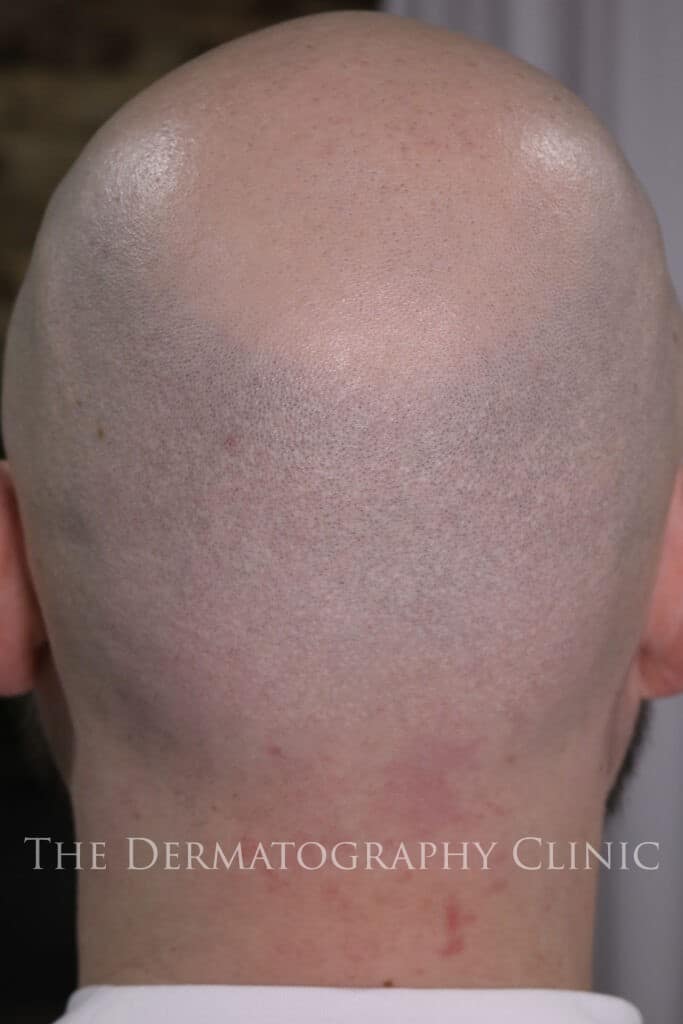
- This image shows the client’s scalp prior to scalp micropigmentation treatment, with visible reduction in density across the affected areas.
-
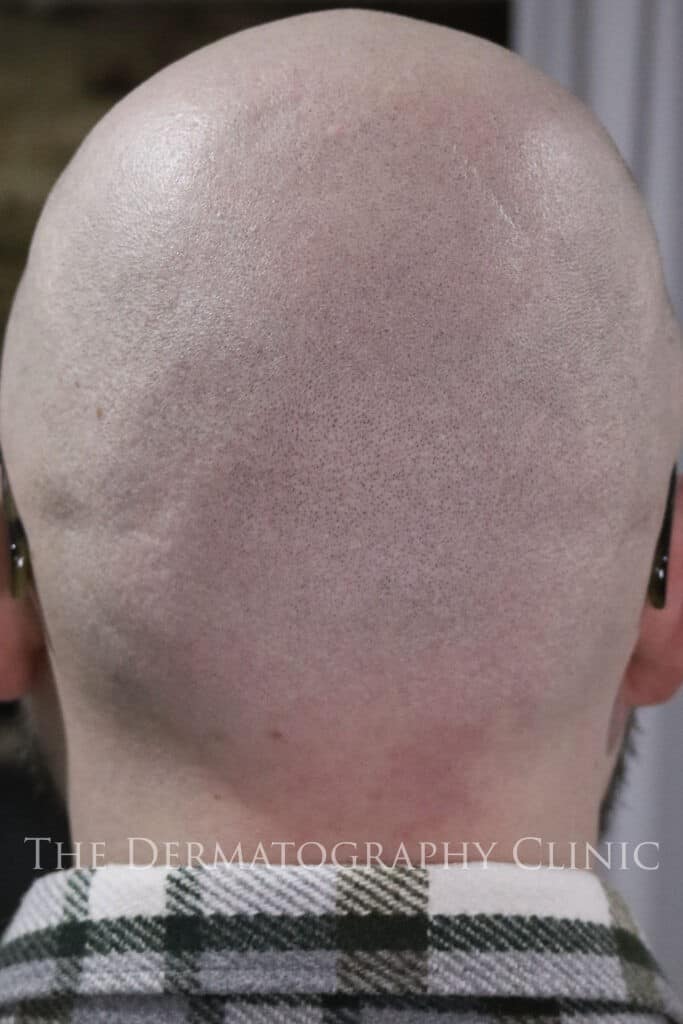
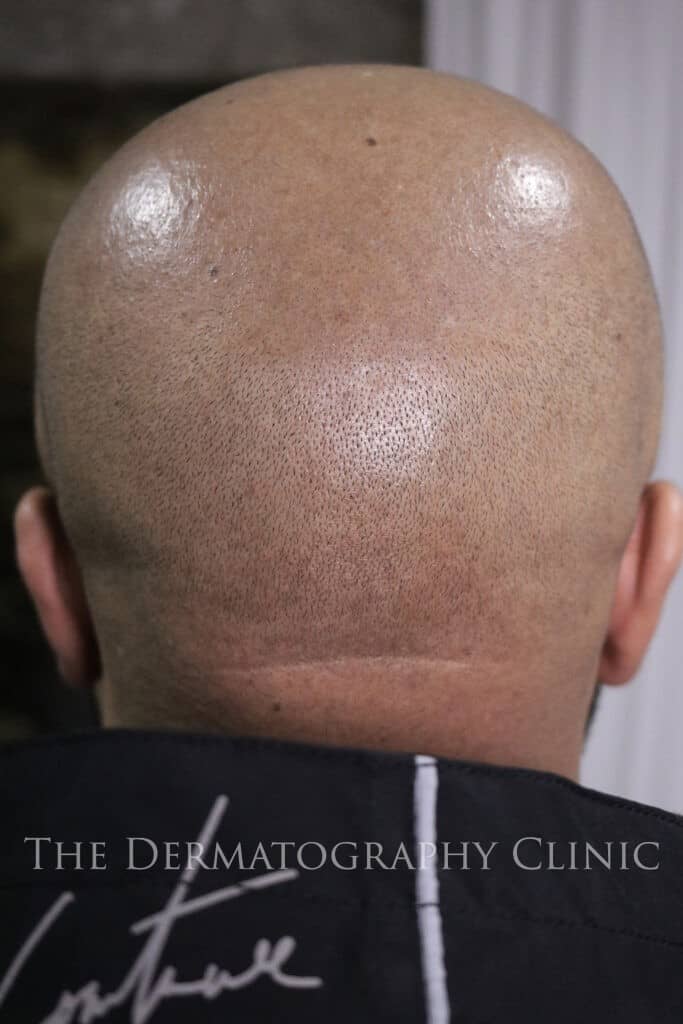
- Healed scalp micropigmentation results — natural density and seamless blending at the back of the head.
-
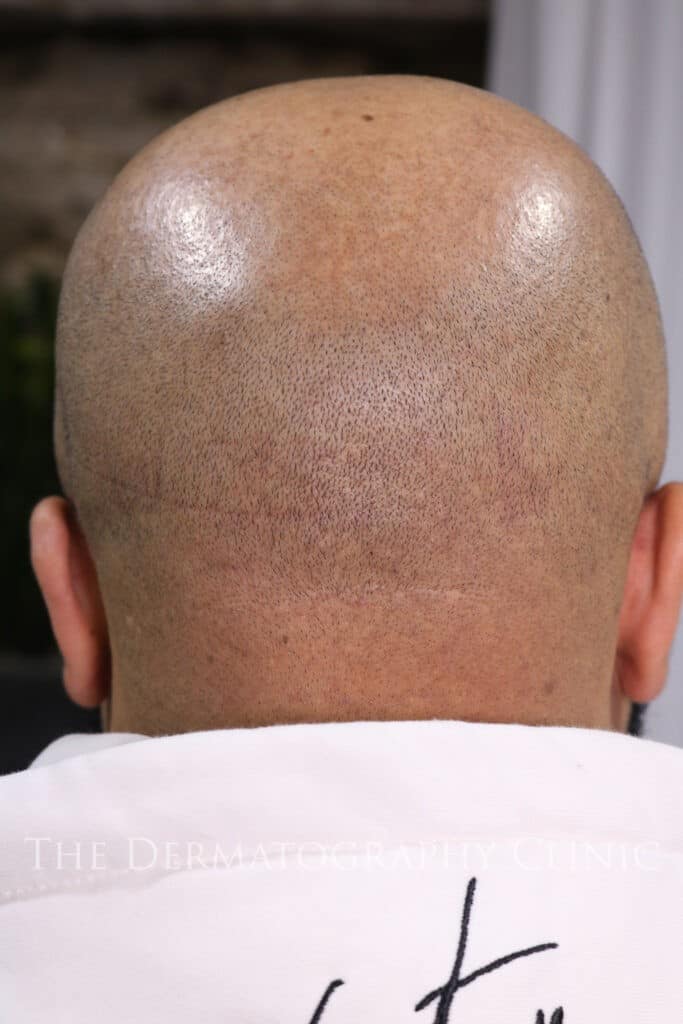
- This image shows the client’s scalp prior to scalp micropigmentation treatment, with visible reduction in density across the scalp.
-
- Healed SMP results showing natural density and a perfectly blended finish at the back of the scalp.
How to assess SMP properly
For anyone considering treatment, the most useful evaluation points are not limited to the hairline.
More clinically relevant considerations include:
- How does the result appear in profile?
- Is there a visible transition line at the sides or back?
- Does it remain consistent in natural daylight rather than controlled lighting?
- Is density balanced across the scalp rather than concentrated in one area?
These factors determine whether the result remains natural beyond the initial treatment phase.
During consultation, I assess the scalp from multiple angles rather than focusing solely on frontal views.
Perspective from within the industry
Having worked in scalp micropigmentation in the UK since it’s earliest years, I’ve seen the field evolve significantly in both technique and accessibility. Earlier practice varied widely in standard and approach. Today, while SMP is more widely available, outcomes still vary significantly depending on training, experience, and clinical judgement.
Increased accessibility has also led to a rise in high-volume treatment environments, alongside a strong emphasis on immediate post-treatment imagery across digital platforms, where visual impact is prioritised over healed outcome.
In contrast, the most consistently natural long-term results tend to come from approaches that prioritise structure, restraint, and full scalp assessment. The best long-term outcomes depend less on initial impact and more on how the pigment behaves as it settles into the skin over time. Clients who have experienced SMP over time often place greater value on realism that continues to hold up in everyday conditions.
Maintenance also plays a critical role. SMP outcomes are not defined solely by the initial treatment. When follow-up sessions are not carefully controlled, there is a risk of gradual oversaturation, where detail begins to soften and the result can appear heavier than intended.
In well-managed cases, maintenance is approached conservatively. Rather than continuously increasing density, pigment is added selectively to preserve texture, variation, and definition.
Closing perspective
Scalp micropigmentation is often presented as a straightforward cosmetic procedure. In practice, it is a study of visual balance and a highly technical process governed by structure, restraint, and precision.
The difference between acceptable and exceptional work is not always immediately visible in post-treatment photography, where pigment appears sharper before full healing has occurred.
A strong outcome is defined by natural blending through the back and sides of the scalp and how well it holds up over time.
Frequently Asked Questions
See the SMP section of our FAQ page for general treatment questions.
How can you tell when SMP is well executed?
A well-executed SMP result should blend naturally into the existing hair pattern without drawing attention to itself. It should remain consistent across different lighting conditions and viewing angles, without visible edges or concentrated areas of pigment.
Why do some SMP results become detectable over time?
Detectable results usually occur when density, blending, or placement has not been balanced correctly across the entire scalp. Over time, issues such as over-density, poor tapering, or uneven layering become more visible as the pigment settles.
What factors determine whether SMP looks natural?
Natural results depend on how well the treatment respects the scalp’s existing structure, including gradual changes in density, head shape, and hair pattern. Consistency across the full scalp is more important than the appearance of the hairline alone.
How important is blending across the full scalp?
Blending is critical because natural hair density does not stop or start abruptly. Poor transitions between treated and untreated areas are one of the main reasons SMP can appear artificial.
Why do healed SMP results matter more than immediate photos?
Healed results provide a more accurate representation of quality because pigment softens and stabilises after the skin has fully healed. Immediate post-treatment images often appear sharper and more defined than the long-term outcome.
Considering scalp micropigmentation?
Natural-looking SMP begins long before treatment starts. Every scalp presents differently, which is why assessment should always precede treatment planning.
A professional consultation is always the first step for an expert-led approach, allowing suitability to be properly assessed before any treatment is planned. Taking time at this stage can significantly influence final results, helping ensure a balanced and natural outcome.